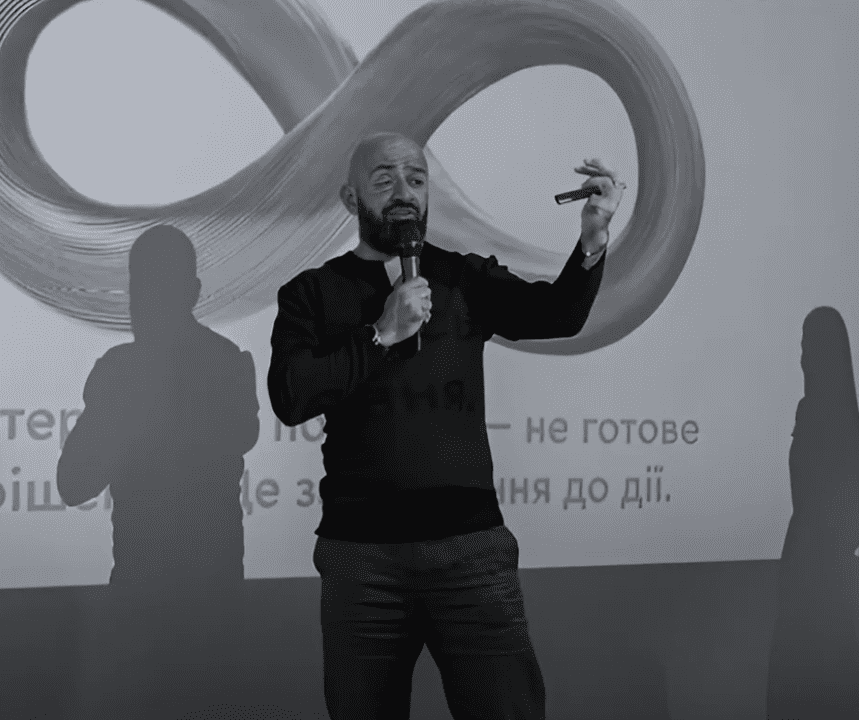
During the speech of our partner Masi Nayem at the BOARD community meeting, this question was raised at every step. And we are pleased that today it is being raised not only by lawyers but also by Ukrainian business.
Veteran policy in the BOARD business community is not about formal initiatives, but about knowledge and responsibility. We understand that returning from war is not the end of history, but its continuation in new conditions. Therefore, the approach should be based on respect, equality, co-creation and a conscious attitude to the experience of female and male veterans.
Veteran policy is not about loud gestures. It is about respect, inclusion, partnership, knowledge and strategy.
Masi Nayyem spoke about the main thing at the meeting:
Why respect is not only about words, but also about actions.
Why we should not heroize or isolate veterans.
Why “nothing about veterans without veterans” should be a rule, not a slogan.
And why support is not about weakness, but about the strength of the community.
He shared the practices we implement at Miller:
A humane return to work after service.
Full voluntariness of participation in the initiatives.
Trauma-informed approach and language sensitivity.
Honoring not only loss but also resilience.
For us, as a law firm, it is important not only to know the law. It is also important to put values above formalities.
Because a veteran is not an object of assistance. A veteran is a partner whom we trust. And whom we support.
Під час виступу нашого партнера Масі Найєма на зустрічі спільноти BOARD – це питання звучало на кожному кроці. І ми раді, що сьогодні воно звучить не лише з вуст правників, а й у колах українського бізнесу.
Ветеранська політика в бізнес-спільноті BOARD — це не про формальні ініціативи, а про знання та відповідальність. Ми розуміємо, що повернення з війни — це не кінець історії, а її продовження в нових умовах. Тому в основі підходу має бути повага, рівність, співтворення та усвідомлене ставлення до досвіду ветеранів і ветеранок.
Ветеранська політика — не про гучні жести. Це про повагу, включення, партнерство, знання і стратегію.
Масі Найєм на зустрічі говорив про головне:
Чому повага — це не тільки слова, а й дії.
Чому ми не маємо героїзувати або ізолювати ветеранів.
Чому «нічого про ветеранів — без ветеранів» має бути правилом, а не лозунгом.
І чому підтримка — це не про слабкість, а про силу спільноти.
Він поділився практикою, яку ми втілюємо у Miller:
Людяне повернення до роботи після служби.
Повна добровільність участі в ініціативах.
Травмоінформований підхід і мовна чутливість.
Вшанування не лише втрат, а й стійкості.
Для нас, як юридичної компанії, важливо не тільки знати закон. А й ставити цінності вище формальностей.
Бо ветеран — не об’єкт допомоги. Ветеран — це партнер, якому ми довіряємо. І якого ми підтримуємо.
The war changed the country, and it changed the very understanding of law: its boundaries, application, responsibility, and even its moral value.
That is why Miller has become a general partner of the First Forum on Military Law organized by the Ukrainian Bar Association, Taras Shevchenko National University of Kyiv and the Institute of Lawmaking of the National Academy of Sciences of Ukraine.
For us, this is not just a professional event. This is a logical continuation of our work in the field of military law: from legal defense and counseling to public and institutional changes. It is a way to strengthen those who are fighting and those who are returning. This is about respect for the military and the state’s responsibility to them.
In the program:
Protecting the rights and legitimate interests of military personnel and their families.
Legal Support for Defense, Military Duty and Service: Challenges and Solutions.
Formation of the military justice system: synergy of legal and political approaches.
Masi Nayyem, the founder of Miller Law Firm and NGO Principle, will moderate the session on the development of military justice.
September 10, Kyiv / online
10:00 – 17:00
Participation is free for military personnel (by prior request: forum@uba.ua)
We believe that a strong army needs a strong law. And we are doing everything to make it work not on paper, but on the side of those who are defending the country.
Війна змінила країну, і змінила саме розуміння права: його межі, застосування, відповідальність і навіть моральну вартість.
Саме тому Miller став генеральним партнером Першого форуму з військового права, який організовують Асоціація правників України / Ukrainian Bar Association, КНУ імені Тараса Шевченка та Інститут правотворчості НАН України.
Для нас це не просто професійна подія. Це логічне продовження нашої роботи у сфері військового права: від юридичного захисту й консультування — до публічних і інституційних змін. Це спосіб підсилювати тих, хто воює, і тих, хто повертається. Це про повагу до військових і відповідальність держави перед ними.
У програмі:
Захист прав і законних інтересів військовослужбовців та членів їхніх сімей.
Правове забезпечення оборони, військового обов’язку та служби: виклики і рішення.
Формування системи військової юстиції: синергія правового та політичного підходів.
Одним з модераторів сесії про розвиток військової юстиції стане засновник Miller Law Firm та ГО «Принцип» Masi Nayyem.
10 вересня, Київ / онлайн
10:00 – 17:00
Участь для військових безкоштовна (за попереднім запитом: forum@uba.ua)
Ми віримо: сильна армія потребує сильного права. І робимо все, щоб воно працювало не на папері, а на боці тих, хто захищає країну.
After 20 years of existence, the Commercial Code has been abolished in Ukraine. All commercial relations are now regulated by the Civil Code of Ukraine. This is a real step towards European integration, but in practice the changes will not affect everyone equally.
The practice of dividing into civil and commercial codes is a feature inherent in post-Soviet countries. In European countries, the dualism of private law (the parallel existence of civil and commercial law) ended in the 19th century with the adoption of the Commercial Code of 1808 in France and the Commercial Code of 1897 in Germany, which became a logical continuation of the civil codes, rather than separate systems.
The Soviet system created its own version of dualism – economic law for a planned economy. Ukraine inherited this model and preserved it even after the transition to a market economy.
Law No. 4196-IX was adopted back in January 2025, signed by the President in February, but came into effect on August 28, 2025. This document finally eliminates dualism in corporate law. Let’s figure out what this means for business and why the legislator decided to do it now.
Why was the Economic Code abolished during the war?
Bringing Ukrainian legislation into line with European Union standards is the main goal of the reform. European countries do not have separate economic codes; all commercial relations are regulated by civil law.
At the same time, it also solves internal problems. The Commercial and Civil Codes created legal uncertainty due to contradictions between their norms. A single basic law simplifies law enforcement for businesses and courts.
Why now? Ukraine is obliged to implement the Association Agreement with the European Union, and the war, paradoxically, accelerates the European integration processes. The legislator expects that a simplified legal framework will facilitate the attraction of foreign investments for the future reconstruction of the country.
Who will be affected by the changes: a large distribution
Small and medium-sized private businesses will feel the changes minimally. At most, they will have to correct their charters where there are references to the norms of the Commercial Code.
Large private businesses will have more work to do with adaptation. Large corporations often have complex internal regulations, contractual templates, and corporate procedures that were based on the norms of the Commercial Code of Ukraine. It will be necessary to review the entire documentary base for references to the abolished norms and bring it into line with the Civil Code of Ukraine. But this is technical work that does not change the essence of business processes.
State and municipal enterprises are facing radical changes. The law prohibits the creation of new legal entities in the following organizational and legal forms:
state-owned enterprises (commercial and non-commercial)
utilities
joint utility companies
private enterprises
innovative enterprises
enterprises of public associations, religious organizations, trade unions
consumer cooperative enterprises
Existing enterprises of these forms have three years to reorganize into limited liability companies (LLCs) or joint-stock companies (JSCs).
The ownership remains state or communal – only the organizational and legal form changes.
Why did the state decide to eliminate “state” and “municipal” enterprises in their old form?
Because the format of state/municipal unitary enterprises is recognized as outdated and opaque. Outdated forms do not meet the corporate governance standards that exist in the EU and according to OECD recommendations.
The reform involves corporatization: all state and municipal enterprises must be transformed into joint-stock companies or LLCs (or non-profit organizations where the state/community will own 100% of the shares). This allows the state owner to receive profit not just from asset management, but from capital.
Accordingly, transparency and accountability are increasing: property transactions should be conducted through open auctions (“Prozorro”), financial statements will be published, etc. Thus, the state is abandoning direct management of “nationalized” enterprises in favor of modern corporate mechanisms, which will promote transparency and attract investment.
How will this affect investors: will it be easier or more difficult for them to enter Ukraine?
This should make it easier for investors to enter. The transition to a single system of legal norms makes the regulatory environment more transparent and predictable. Investors like it when the rules are clear: now they don’t have to decide which code to apply to a contract or property relations. As a result, Ukraine is getting closer to the legal standards of the European Union, and therefore it will be clearer and safer for foreign investors to invest here.
Three years for adaptation: what needs to be done by 2028?
Law No. 4196-IX establishes a transitional period of three years from the date of its entry into force (i.e. from August 28, 2025 to August 28, 2028).
During this time, special regulations are in effect that gradually convert state and municipal enterprises into modern forms (JSC or LLC) and adapt all regulatory acts. Such a “soft start” is designed to give businesses enough time to re-register, update contracts and make other changes. During this transition period, enterprises are recommended to gradually update their documents and prepare to work under the new rules.
What happens if the company does not have time to change the documents?
If a company does not adapt its documents by the end of the transition period, this may lead to legal uncertainty and risks.
In particular, companies with outdated organizational forms will not be able to make changes to the Unified State Register from 2028, except in cases of liquidation or bankruptcy. This means that the company will not be able to change the manager or the composition of participants, which may complicate operations.
For state-owned enterprises, the law provides for a stricter scenario: if within the first 6 months after the law comes into force, the management does not make a decision to transform into an LLC or JSC, the property of such enterprises will be transferred to the State Property Fund.
Contracts and documents: what to rewrite?
First of all, you need to check the constituent documents and contracts. The charters (constituent agreements) of companies that contain references to the norms of the Commercial Code of Ukraine may contain outdated or inconsistent provisions with the new legislation.
You should also review the templates of contracts and agreements: they may contain special wording referring to the Commercial Code of Ukraine or a “commercial contract.” If such are found, they should be replaced with references, in particular, to the norms of the Civil Code of Ukraine.
In general, it is recommended to audit the company’s internal regulations (for example, regulations on the liability of managers or management bodies) to ensure that they do not contradict the updated rules.
Charters and founding agreements – if there are references to the Commercial Code of Ukraine, amendments should be made;
Agreements and contracts – review standard forms (supply agreement, lease, etc.), remove references to the Commercial Code of Ukraine;
Internal documents (regulations, orders) – make sure that job descriptions or management mechanisms comply with the Civil Code of Ukraine.
This will avoid misunderstandings and automatically convert the business into a new legal reality.
What will happen to the employees?
For employees of enterprises undergoing reorganization, nothing much will change. Labor relations will be preserved in full.
Risks arise only if the enterprise decides to liquidate instead of reorganize or fails to comply with the requirements of the law. In that case, its fate will be decided by the State Property Fund.
Will it become easier to resolve disputes?
Absolutely yes. Instead of two codes that sometimes contradicted each other, now there will be a basic Law for all market participants.
This will reduce the legal burden on businesses and simplify the work of lawyers. It will also be easier for foreign investors to understand the “rules of the game” – because the system will become similar to the European one.
Conclusion
The repeal of the Commercial Code is not a revolution, but an evolution. Private business will feel the changes minimally, but state-owned enterprises will have to work hard.
The main goal of the reform is to create a more transparent legal framework that is understandable to European partners and investors. And in this context, the abolition of dualism in corporate law is a logical step.
Dmytro Derkach, an attorney in the dispute resolution practice of Miller Law Firm, for Business Censor.
Після 20 років існування в Україні скасували Господарський кодекс. Всі комерційні відносини тепер регулює Цивільний кодекс України. Це справжній крок до європейської інтеграції, але на практиці зміни торкнуться не всіх однаково.
Практика розділення на цивільний та господарський кодекси – це особливість, притаманна пострадянським країнам. У європейських країнах дуалізм приватного права (паралельне існування цивільного і торгового права) закінчився ще у XIX столітті з прийняттям у Франції Торгового кодексу 1808 року та Торгового кодексу Німеччини 1897 року, які стали логічним продовженням цивільних кодексів, а не окремими системами.
Радянська система створила власний варіант дуалізму – господарське право для планової економіки. Україна успадкувала цю модель і зберігала її навіть після переходу до ринкової економіки.
Закон №4196-IX прийняли ще у січні 2025 року, у лютому його підписав Президент, але в дію він вступив 28 серпня 2025 року. Цей документ остаточно ліквідує дуалізм у корпоративному праві. Розберемося, що це означає для бізнесу і чому законодавець вирішив це зробити саме зараз.
Чому скасували Господарський кодекс під час війни?
Приведення українського законодавства у відповідність до стандартів Європейського Союзу – головна мета реформи. У європейських країнах немає окремих господарських кодексів, всі комерційні відносини регулює цивільне право.
Водночас це вирішує і внутрішні проблеми. Господарський та Цивільний кодекси створювали правову невизначеність через суперечності між їх нормами. Єдиний базовий закон спрощує правозастосування для бізнесу і судів.
Чому саме зараз? Україна зобов’язана виконувати Угоду про асоціацію з Європейським Союзом, а війна, як це не парадоксально, прискорює євроінтеграційні процеси. Законодавець розраховує, що спрощене правове поле сприятеме залученню іноземних інвестицій для майбутньої відбудови країни.
Кого торкнуться зміни: великий розподіл
Малий та середній приватний бізнес відчує зміни мінімально. Максимум – доведеться підправити статути там, де є посилання на норми Господарського кодексу.
Великий приватний бізнес матиме більше роботи з адаптацією. Великі корпорації часто мають складні внутрішні регламенти, договірні шаблони та корпоративні процедури, які базувалися на нормах Господарського кодексу України. Потрібно буде переглянути всю документальну базу на предмет посилань на скасовані норми та привести її у відповідність до Цивільного кодексу України. Але це технічна робота, яка не змінює суті бізнес-процесів.
Державні та комунальні підприємства чекають кардинальні зміни. Закон забороняє створювати нові юридичні особи у таких організаційно-правових формах:
державні підприємства (комерційні та некомерційні)
комунальні підприємства
спільні комунальні підприємства
приватні підприємства
іновативні підприємства
підприємства громадських об’єднань, релігійних організацій, профспілок
підприємства споживчої кооперації
Існуючі підприємства цих форм мають три роки на реорганізацію в товариства з обмеженою відповідальністю (ТОВ) або акціонерні товариства (АТ).
Власність при цьому залишається державною чи комунальною – змінюється тільки організаційно-правова форма.
Чому держава вирішила прибрати “державні” та “комунальні” підприємства у старому вигляді?
Тому що формат державних/комунальних унітарних підприємств визнаний застарілим і непрозорим. Застарілі форми не відповідають стандартам корпоративного управління, які існують в ЄС та за рекомендаціями OECD.
Реформа передбачає корпоратизацію: усі державні та комунальні підприємства мають бути перетворені у АТ або ТОВ (або неприбуткові організації, де держава/громада володітиме 100% акцій). Це дає змогу отримувати держвласнику прибуток не просто від управління активами, а від капіталу.
Відповідно підвищуються прозорість і підзвітність: операції з майном мають проводитися через відкриті аукціони (“Прозорро”), публікуватиметься фінансова звітність тощо. Отже, держава відмовляється від прямого управління “націоналізованими” підприємствами на користь сучасних корпоративних механізмів, що сприятиме прозорості і залученню інвестицій.
Як це вплине на інвесторів: їм буде легше чи важче заходити в Україну?
Це повинно полегшити вхід інвесторам. Перехід на єдину систему правових норм робить регуляторне середовище прозорішим і передбачуванішим. Інвестори люблять, коли правила є зрозумілими: тепер не доведеться розділяти, який кодекс застосовувати до контракту чи майнових відносин. У підсумку Україна стає ближчою до правових стандартів Європейського Союзу, а відтак іноземним інвесторам буде зрозуміліше і безпечніше вкладати кошти тут.
Три роки на адаптацію: що потрібно встигнути до 2028-го?
Закон №4196-ІХ встановлює перехідний період тривалістю три роки з моменту набрання ним чинності (тобто з 28 серпня 2025 по 28 серпня 2028 року).
Протягом цього часу діють особливі норми, які поступово переводять державні й комунальні підприємства в сучасні форми (АТ чи ТОВ) і адаптують усі нормативні акти. Такий “м’який старт” покликаний дати бізнесу достатньо часу для перереєстрації, оновлення договорів та інших змін. За цей перехідний період підприємствам рекомендується поступово оновлювати документи і приготуватися до роботи за новими правилами.
Що буде, якщо компанія не встигне змінити документи?
Якщо компанія не адаптує свої документи до кінця перехідного періоду, це може призвести до правової невизначеності та ризиків.
Зокрема, компанії у застарілих організаційних формах із 2028 року не зможуть вносити зміни до Єдиного державного реєстру, крім випадків ліквідації чи банкрутства. Це означає, що підприємство не зможе міняти керівника чи склад учасників, що може ускладнити операційну діяльність.
Для державних підприємств закон передбачає жорсткіший сценарій: якщо протягом перших 6 місяців після набрання чинності закону керівництво не ухвалить рішення про перетворення в ТОВ або АТ, майно таких підприємств буде передано Фонду державного майна.
Договори та документи: що переписувати?
Насамперед треба перевірити установчі документи та контракти. Статути (установчі договори) компаній, які містять посилання на норми Господарського кодексу України, можуть містити застарілі або невідповідні новому законодавству положення.
Також слід переглянути шаблони договорів і угод: в них можуть бути спеціальні формулювання з посиланням на Господарський кодекс України або “господарський договір”. Якщо такі зустрічаються, їх потрібно замінити посиланнями зокрема на норми Цивільного кодексу України.
У цілому рекомендується провести аудит внутрішніх положень компанії (наприклад положення про відповідальність керівників чи органів управління), щоби впевнитися, що вони не суперечать оновленим правилам.
Статути та установчі договори – якщо там є згадки Господарського кодексу України, слід внести правки;
Договори і контракти – переглянути типові форми (договір поставки, оренди тощо), прибрати посилання на Господарський кодекс України;
Внутрішні документи (положення, накази) – переконатися, що опис посадових обов’язків чи механізми управління відповідають Цивільному кодексу України.
Це дозволить уникнути непорозумінь та автоматично сконвертувати бізнес у нову правову реальність.
Що буде з працівниками?
Для співробітників підприємств, які проходять реорганізацію, особливо нічого не зміниться. Трудові відносини зберігаються в повному обсязі.
Ризики виникають тільки у разі, якщо підприємство вирішить ліквідуватися замість реорганізації або не виконає вимоги закону. Тоді його долю вирішуватиме Фонд державного майна.
Чи стане простіше вирішувати спори?
Безумовно, так. Замість двох кодексів, які іноді суперечили один одному, тепер діятиме основний Закон для всіх учасників ринку.
Це зменшить правове навантаження на бізнес і спростить роботу юристів. Іноземним інвесторам також буде легше розуміти “правила гри” – адже система стане подібною європейській.
Висновок
Скасування Господарського кодексу – це не революція, а еволюція. Приватний бізнес відчує зміни мінімально, а от державним підприємствам доведеться серйозно попрацювати.
Головна мета реформи – створення прозорішого правового поля, зрозумілого для європейських партнерів та інвесторів. І в цьому контексті скасування дуалізму в корпоративному праві – логічний крок.
Дмитро Деркач, адвокат практики вирішення спорів юридичної компанії Miller, для Бізнес Цензор.
We are publishing this statement at the request and with the consent of our client Lilia Averyanova, the mother of Andriy Pilshchikov (“Juice”).
Today, August 25, 2025, is the second anniversary of the death of Andriy Pilshchikov (“Dzhus”), a pilot and Hero of Ukraine. Andriy became a symbol of courage and change in our army for thousands of people, and was one of the most visible ambassadors of the appearance of the F-16 in Ukrainian skies.
His mother, Liliya Averyanova, has been living with the pain of losing her son for two years. And now she has asked to share what she still has to experience because of the actions of the SBI investigators.
What happened:
On July 11, investigators from the State Bureau of Investigation came to Ms. Liliya’s apartment to search it without a court order, citing in the report an “urgent case” in the case of Vitaliy Shabunin.
As a result, they only took copies of documents for Ms. Liliya’s apartment — information that can be obtained from the state registry in a few clicks.
Simultaneously with the search of Ms. Liliya, SBI investigators were conducting investigative actions with the participation of Vitaliy Shabunin in another location.
In simple words, why this is wrong:
Without a trial – only in two extreme cases. The law allows searches without a warrant only when saving life/property or pursuing a suspect “on hot pursuit.” In our situation, there was neither rescue nor persecution: the SBI investigators were with Vitaly Shabunin in another location, and “rescuing” copies of documents for an apartment was absurd.
A search is one of the harshest interferences with human rights. They came to the mother of the fallen Hero without a court order, also for the sake of paper copies. This is excessive, disproportionate and without proper justification. A search is a last resort and the last step. First, a request to provide documents, then a court order for temporary access. Only when this is impossible and there is an immediate risk is a search permitted, and then by court order.
Such actions are an affront to dignity. The state must treat the families of the fallen with special respect. Instead, the “dialogue” between law enforcement officers and Ms. Liliya began with a search of her home. And this is against the background of the fact that the State Bureau of Investigation has been investigating the plane crash in which Andriy died for two years, and during all this time, not a single official conversation between law enforcement officers and the mother has taken place. It is unacceptable to start a conversation with the Hero’s mother by searching her. That can’t be.
Our answer:
We, the Miller team of attorneys, are representing Ms. Lilia pro bono and have already taken the following steps:
We helped Ms. Liliya obtain official victim status in the proceedings regarding the plane crash in which Andriy died. This triggers due process communication, the right to request access to materials, evaluate procedural actions, and receive substantive responses.
We contacted the State Bureau of Investigation for official explanations regarding the reasons for the “urgency” and actions taken during the search. As of August 25, 2025, there is no answer — that is, even here the Hero’s mother is left without an explanation.
We have filed a criminal complaint with the Prosecutor General’s Office and will seek a legal assessment of the actions of all officials who entered Ms. Liliya’s apartment without a court order.
If there is no reaction, we will initiate further checks and appeals within the framework of national and international human rights protection mechanisms so that the decision regarding this situation is not formal, but substantive.
Mrs. Liliya raised the Hero. It is our duty to protect her dignity and right to justice.
Цю заяву, ми оприлюднюємо на прохання та за згодою нашої клієнтки Лілії Авер’янової, матері Андрія Пільщикова («Джуса»).
Сьогодні, 25 серпня 2025 року, друга річниця загибелі Андрія Пільщикова («Джуса») — льотчика, Героя України. Андрій став для тисяч людей символом мужності й змін у нашій армії, був одним із найпомітніших амбасадорів появи F-16 в українському небі.
Його матір, Лілія Авер’янова, два роки вона живе з болем утрати сина. І нині вона звернулася з проханням поділитися тим, що їй ще доводиться переживати через дії слідчих ДБР.
Що сталося:
11 липня слідчі Державне бюро розслідувань прийшли до квартири пані Лілії з обшуком без ухвали суду, пославшись у протоколі на «невідкладний випадок» у справі Віталія Шабуніна.
За підсумком вони забрали лише копії документів на квартиру пані Лілії — інформацію, яку можна отримати з державного реєстру за кілька кліків.
Одночасно з обшуком у пані Лілії, слідчі ДБР проводили слідчі дії за участі Віталія Шабуніна в іншому місці.
Простими словами чому це неправильно:
Без суду — лише у двох крайніх випадках. Закон дозволяє обшук без ухвали тільки коли рятують життя/майно або переслідують підозрюваного «по гарячих слідах». У нашій ситуації не було ні порятунку, ні переслідування: слідчі ДБР були з Віталієм Шабуніним в іншій локації, а «рятувати» копії документів на квартиру — абсурд.
Обшук — це одне з найжорсткіших втручань в права людини. До мами полеглого Героя прийшли без рішення суду, ще й заради паперових копій. Це надмірно, непропорційно та без належних підстав. Обшук — це крайній захід і останній крок. Спершу — прохання надати документи, потім — ухвала суду на тимчасовий доступ. Лише коли це неможливо та є негайний ризик — дозволений обшук і то за рішенням суду.
Такі дії б’ють по гідності. Держава має ставитися до родин полеглих з особливою повагою. Натомість «діалог» правоохоронців із пані Лілією почався з обшуку в її домі. І це на тлі того, що ДБР уже два роки розслідує авіакатастрофу, в якій загинув Андрій, і за весь цей час жодної офіційної розмови правоохоронців з мамою не відбулося. Починати спілкування з мамою Героя з обшуку неприйнятно. Так бути не може.
Наша відповідь:
Ми, команда адвокатів Miller, представляємо пані Лілію pro bono та вже зробили такі кроки:
Ми допомогли пані Лілії отримати офіційний статус потерпілої у провадженні щодо авіакатастрофи, в якій загинув Андрій. Це запускає належну процесуальну комунікацію, право вимагати доступу до матеріалів, оцінювати процесуальні дії та отримувати відповіді по суті.
Ми звернулися до ДБР по офіційні пояснення щодо підстав «невідкладності» та дій під час обшуку. Станом на 25 серпня 2025 року відповіді немає — тобто навіть тут матір Героя залишають без пояснень.
Ми подали заяву про кримінальне правопорушення до Офісу Генерального прокурора та добиватимемось правової оцінки дій усіх посадових осіб, які увійшли до квартири пані Лілії без судової ухвали.
Якщо реакції не буде, ініціюємо подальші перевірки та звернення в межах національних і міжнародних механізмів захисту прав людини, щоб рішення щодо цієї ситуації було не формальним, а змістовним.
Пані Лілія виховала Героя. Наш обов’язок захистити її гідність і право на справедливість.
Yevheniy Skurativsky, attorney at Miller Law Firm, for LAGA:ZAKON
Over the past six months, at least five stories of teenagers beating, raping, or harassing have made headlines. The beating of a girl in Bila Tserkva was just one of them. And how many similar cases are there that our society will never learn about?
In such stories, the question always arises: are the children responsible? And the parents?
In this article, we clearly, simply, and with examples, analyze when a minor is criminally liable, what threatens his parents, and why in our outdated system, the law and courts do not deter teenage violence.
At what age is criminal liability established?
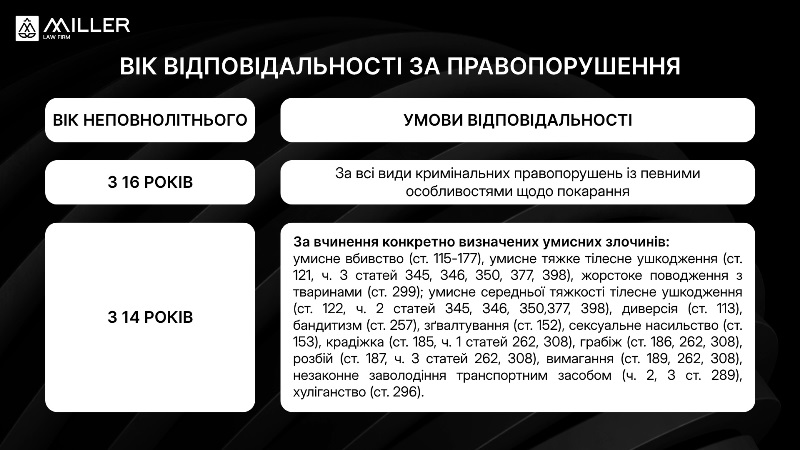
From the age of 16, a child bears criminal responsibility as an adult (but with certain mitigations).
From the age of 14 – for serious intentional crimes: murder, rape, robbery, burglary, extortion, hooliganism, etc.
More details in the infographic:
For minors found guilty of committing a criminal offense, according to Article 98 of the Criminal Code of Ukraine, the court may apply the following main types of punishments:
probation supervision;
fine;
public works;
corrective work;
arrest (from the age of 16);
imprisonment for a certain period of time.
Minors may also be subject to additional penalties in the form of a fine and deprivation of the right to hold certain positions or engage in certain activities.
It is important that such types of punishments as confiscation of property (as the main punishment), restriction of liberty, and life imprisonment cannot be applied to minors.
That is, nothing out of the ordinary, general liability, as for all those guilty of criminal offenses with specific features.
If a minor has not reached the appropriate age at the time of committing criminal acts, he is not subject to criminal liability.
What about children who are too young to be criminally responsible?
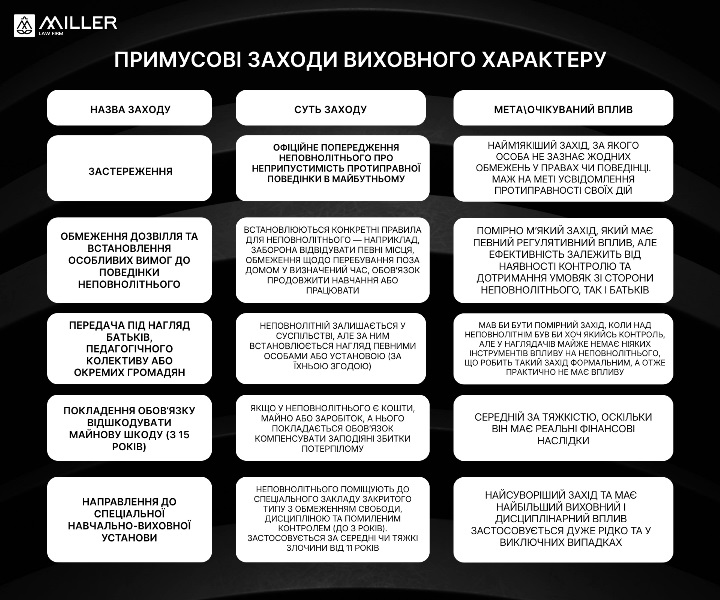
Compulsory educational measures – what are they? This is something like a “soft punishment” – not criminal, but formally through the court. They can be applied instead of a criminal record and to children who have reached the age of responsibility.
In the first case, we are talking about a case where a minor has committed a misdemeanor or a negligent non-serious crime and the prosecutor believes that such a minor can be corrected without the application of criminal punishment, and instead files a petition with the court for the application of compulsory educational measures and effectively releases the person from criminal liability.
In the second case, minors who have not reached the age of criminal responsibility. For them, educational measures remain the only possible option.
So, we’ve figured out what, when, and to whom it applies. Now it’s time to talk about the types of compulsory educational measures and their real effectiveness. Coercive measures of an educational nature in Part 2 of Article 105 of the Criminal Code of Ukraine include:
1) Warning – a verbal warning. The mildest.
2) Restrictions on leisure – a ban on walking in the evening, an obligation to study or work.
3) Transfer to supervision (usually to parents). Effectiveness is questionable.
4) Property damage if the child is 15+ and has property or income.
5) A closed educational institution is actually a “reform colony”, the most severe measure.
Important: the court may impose one or more compulsory educational measures at its own discretion, regardless of those that the prosecutor may waive.
What if the child simply ignores the educational measures?
If she is 14+ and could already be held criminally liable, but she was released, then she may be held criminally liable for failure to comply with the measures.
If she’s under 14, then… nothing.
There are no additional sanctions. Zero impact.
Perhaps the only available legal instrument is to hold parents or legal representatives administratively liable under Article184 of the Code of Administrative Offenses (failure to fulfill obligations regarding the upbringing of a child) and possibly even to deprive them of parental rights.
What are the risks for parents if their child breaks the law?
If a child does something illegal or ignores educational measures, his parents can be held liable. This is provided for Article 184 of the Code of Administrative Offenses .
After all, Article 150 of the Family Code of Ukraine imposes on parents the obligation to raise a child in a spirit of respect for the rights and freedoms of other people, to take care of his health, physical, spiritual and moral development, education and prepare for independent life. If a child demonstrates behavior that is far from these ideals, this is a direct indicator that the parents have not coped with their mission.
What threatens:
Warnings or fines from 850 to 5100 UAH – depending on the situation.
Deprivation of parental rights – if the child’s behavior is systemic, and the parents have completely removed themselves.
Liability under Article 184 of the Code of Administrative Offenses arises if:
Parents do not fulfill their responsibilities regarding upbringing (parts 1 – 2);
A child aged 14 – 16 committed an administrative offense (part 3);
The child did something that is a criminal offense in substance, but she is too young for the Criminal Code (Part 4).
That is, the law clearly establishes: parents are directly responsible for creating appropriate conditions for the child’s development and for preventing his or her illegal behavior.
What’s wrong with this system?
A fine of 850 UAH or even 5100 UAH is unlikely to be a “wake-up call” for parents who have been ignoring their child for years. Formally, the tools are there, but the impact is minimal.
Moreover, when a minor does not even comply with compulsory educational measures, this is another signal that the parents have failed. And again: the maximum is an administrative fine.
In practice, the pressure on parents is mild and often does not work.
What’s in the White Church case?
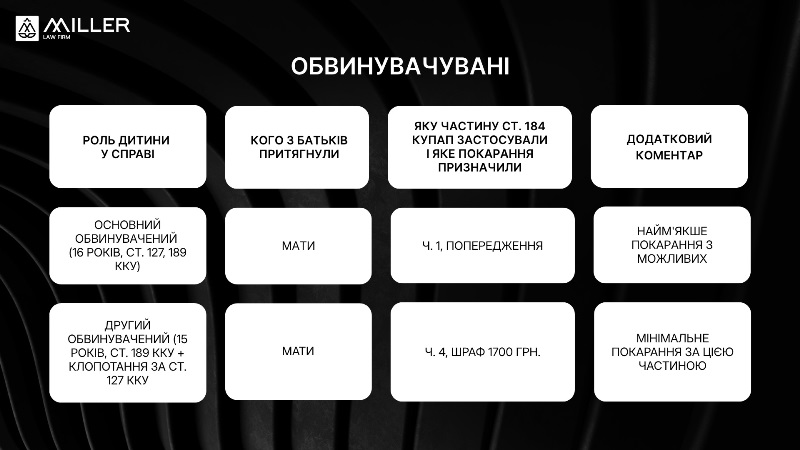
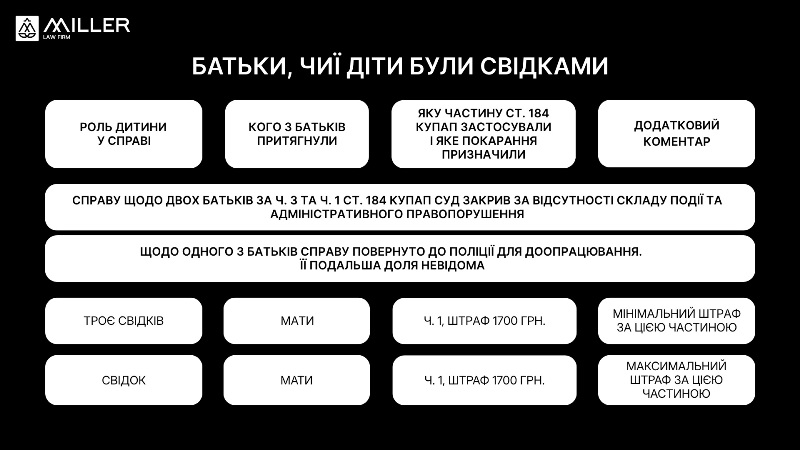
Now let’s return to the case from Bila Tserkva, which became an illustrative example of what holding parents accountable looks like in practice and how the judges “assessed” the responsibility of the parents of the participants and witnesses of this event:
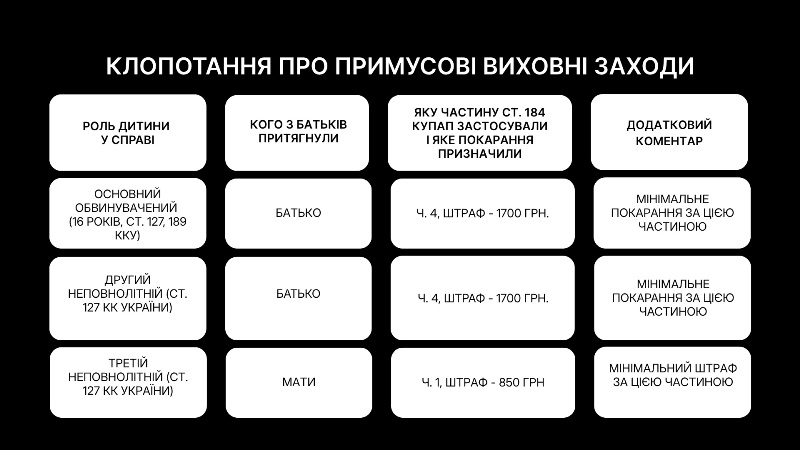
And now the most interesting thing – the parents of the children, who were only witnesses or present, but, according to available information, did not take an active part in the beating:
As we can see, in practice there is complete inconsistency.
Parents of children suspected of committing a crime often receive the mildestpunishments – a warning or a minimal fine. At the same time, the courts punish parents of those who were only witnesses or simply present at the scene of the crime severely – sometimes to the maximum extent of the article.
There are cases when:
Some cases are closed because “they didn’t see any guilt”;
others do not, although the circumstances are practically identical.
The problem is in the approach. Courts almost never analyze the real role of parents:
Were they indifferent?
Did you try to educate?
Did they have any influence on the child at all?
The principle of individualization of responsibility is absent.
It seems that decisions are made “by eye”, without uniform criteria and logic. As a result, a system where it is not the fact of guilt that determines the punishment, but the subjective assessment of a particular judge
As a result: the administrative responsibility of parents is a lottery. Someone “won” – they were simply reprimanded. Another “lost” and paid a fine, although they did no more (and sometimes less).
Conclusions
So, the law is there. And the mechanisms too. But in reality, everything is too soft, outdated, inconsistent and often unfair. Children who break the law do not always feel the consequences. Parents who did not raise them are mostly punished with symbolic fines. And society and the victims pay the highest price.
Here is a logical question: if the system is not working, maybe it is worth looking at the experience of other countries? The legislation of Germany, Lithuania or Switzerland is similar to ours, but works better. The point is not in the laws, but in the philosophy. There, the emphasis is not on formal punishment, but on real change in behavior: a teenager may be required to undergo a psychological program, improve grades, work hours for the benefit of the community or temporarily go under the supervision of a special curator.
Ukraine should not just increase fines, but modernize the system. First of all, expand the list of educational measures: introduce mandatory psycho-correctional programs, socially useful works with a clear scope, real probation supervision. Also, make the responsibility of parents more meaningful: instead of symbolic fines, mandatory courses or social support. The biggest gap is the lack of consequences for ignoring educational measures by children who have not yet reached the age of criminal responsibility. It must be eliminated.
The conclusion is obvious: the law exists, but it does not work properly. Neither children nor parents feel true responsibility. And impunity breeds even greater cruelty. The goal should not be formal punishment, but the upbringing of a responsible citizen. And this requires not fines “for show”, but modern effective tools – like in countries where the system really works.
Євгеній Скуратівський, адвокат Miller Law Firm, для LAGA:ZAKON
За останні пів року щонайменше п’ять історій про підлітків, які били, ґвалтували чи цькували, потрапили в заголовки новин. Побиття дівчини в Білій Церкві стало лише однією з них. А скільки подібних випадків, про які наше суспільство ніколи не дізнається?
У таких історіях завжди виникає питання: чи відповідають діти? А батьки?
У цій статті чітко, просто і з прикладами розбираємо, коли неповнолітній несе кримінальну відповідальність, що загрожує його батькам і чому в нашій застарілій системі закон і суди не стримують підліткове насильство.
З якого віку кримінальна відповідальність?
З 16 років дитина несе кримінальну відповідальність як дорослий (але з певними пом’якшеннями).
З 14 років – за тяжкі умисні злочини: убивство, зґвалтування, грабіж, розбій, вимагання, хуліганство тощо.
Детальніше в інфографіці:
Для визнаних винними у вчиненні кримінального правопорушення неповнолітніх згідно зі ст. 98 КК України суд може застосувати такі основні види покарань:
пробаційний нагляд;
штраф;
громадські роботи;
виправні роботи;
арешт (з 16 років);
позбавлення волі на певний строк.
Також до неповнолітніх можуть бути застосовані додаткові покарання у виді штрафу та позбавлення права обіймати певні посади або займатися певною діяльністю.
Важливо, що до неповнолітніх не можуть застосовуватися такі види покарань, як конфіскація майна (як основне покарання), обмеження волі та довічне позбавлення волі.
Тобто нічого не звичного, загальна відповідальність, як і для всіх винних у кримінальних правопорушеннях з особливостями.
Якщо ж неповнолітній на час вчинення карних дій не досяг належного віку – він не підлягає кримінальній відповідальності.
Що з дітьми, які занадто малі для кримінальної відповідальності?
Примусові заходи виховного характеру – що це? Це щось на кшталт «м’якого покарання» – не кримінальне, але формально через суд. Їх можуть застосовувати замість судимості і до дітей, які досягли віку відповідальності.
У першому випадку ми говоримо про випадок, коли неповнолітній вчинив проступок або необережний нетяжкий злочин і прокурор вважає, що такий неповнолітній може бути виправлений без застосування кримінального покарання, і замість цього подає до суду клопотання про застосування примусових заходів виховного характеру і фактично звільняє особу від кримінальної відповідальності.
У другому випадку неповнолітні, які не досягли віку кримінальної відповідальності. Для них виховні заходи залишаються єдиним можливим варіантом.
Отже, ми розібралися, що, коли й до кого застосовується. Тепер варто поговорити про види примусових виховних заходів та їх реальну ефективність. До примусових заходів виховного характеру у ч. 2 ст. 105 КК України належать:
1) Застереження – усне попередження. Найм’якше.
2) Обмеження дозвілля – заборона гуляти ввечері, обов’язок вчитись або працювати.
3) Передача під нагляд (зазвичай батькам). Ефективність – сумнівна.
4) Майнова шкода, якщо дитині 15+ і вона має майно або доходи.
5) Закритий навчальний заклад – це фактично «виховна колонія», найсуворіший захід.
Важливо: суд може призначити один або декілька примусових заходів виховного характеру за власним переконанням, незважаючи на ті, про які простить прокурор.
Що, якщо дитина просто ігнорує виховні заходи?
Якщо їй 14+, і вона вже могла б нести кримінальну відповідальність, але її звільнили, то за невиконання заходів її можуть притягнути до кримінальної відповідальності.
Якщо їй менше 14, то… нічого.
Немає додаткових санкцій. Вплив нульовий.
Можливий єдиний доступний юридичний інструмент – це притягнення батьків або законних представників до адміністративної відповідальності за статтею 184 КУпАП (невиконання обов’язків щодо виховання дитини) та можливо навіть позбавлення батьківських прав.
Що загрожує батькам, якщо дитина порушує закон?
Якщо дитина чинить щось протиправне або ігнорує виховні заходи – до відповідальності можуть притягнути її батьків. Це передбачено ст. 184 КУпАП.
Зрештою ст. 150 Сімейного кодексу України покладає на батьків обов’язок виховувати дитину в дусі поваги до прав та свобод інших людей, піклуватися про її здоров’я, фізичний, духовний та моральний розвиток, навчання та готувати до самостійного життя. Якщо ж дитина демонструє поведінку, далеку від цих ідеалів, це прямий показник того, що батьки зі своєю місією не впоралися.
Що загрожує:
Попередження або штрафи від 850 до 5100 грн – залежно від ситуації.
Позбавлення батьківських прав – якщо поведінка дитини системна, а батьки повністю самоусунулись.
Відповідальність за ст. 184 КУпАП настає, якщо:
Батьки не виконують своїх обов’язків щодо виховання (ч. ч. 1 – 2);
Дитина 14 – 16 років вчинила адмінправопорушення (ч. 3);
Дитина зробила щось, що за змістом – кримінальний злочин, але вона замала для КК (ч. 4).
Тобто закон чітко встановлює: батьки несуть пряму відповідальність за створення належних умов для розвитку дитини та за попередження її протиправної поведінки.
Що не так із цією системою?
Штраф у 850 грн або навіть 5100 – навряд чи стане «дзвінком» для батьків, які роками ігнорують дитину. Формально інструменти є, але вплив – мінімальний.
Ба більше, коли неповнолітній навіть не виконує примусові заходи виховного характеру, – це ще один сигнал, що батьки не впорались. І знову: максимум – адміністративний штраф.
На практиці – тиск на батьків м’який і часто не спрацьовує.
А що в кейсі Білої Церкви?
Тепер повернемося до кейсу з Білої Церкви, який став показовим прикладом того, як на практиці виглядає притягнення батьків до відповідальності і як судді “оцінили” відповідальність батьків учасників та свідків цієї події:
А тепер найцікавіше – батьки дітей, які були лише свідками або присутніми, але, за наявною інформацією, не брали активної участі у побитті:
Як бачимо, на практиці – повна непослідовність.
Батьки дітей, яких підозрюють у вчиненні злочину, часто отримують найм’якші покарання – попередження або мінімальний штраф. А водночас батьків тих, хто був лише свідком або просто присутній на місці події, суди карають суворо – іноді максимально в межах статті.
Трапляються випадки, коли:
одні справи закривають, бо «не побачили вини»;
інші – ні, хоча обставини практично ідентичні.
Проблема – в підході. Суди майже не аналізують реальну роль батьків:
Чи були вони байдужими?
Чи намагались виховувати?
Чи взагалі мали хоч якийсь вплив на дитину?
Принцип індивідуалізації відповідальності – відсутній.
Складається враження, що рішення ухвалюються «на око», без єдиних критеріїв і логіки. Як наслідок – система, де не факт провини визначає покарання, а суб’єктивна оцінка конкретного судді
У результаті: адміністративна відповідальність батьків – це лотерея. Хтось «виграв» – йому просто зробили зауваження. Інший – «програв» і сплатив штраф, хоча зробив не більше (а іноді й менше).
Висновки
Отже, закон є. І механізми теж. Але в реальності все надто м’яко, застаріло, непослідовно і часто несправедливо. Діти, які порушують закон, не завжди відчувають наслідки. Батьки, які їх не виховали, здебільшого відбуваються символічними штрафами. А суспільство та постраждалі платять найвищу ціну.
Тут логічне питання: якщо система не працює, можливо, варто подивитись на досвід інших країн? Законодавство Німеччини, Литви чи Швейцарії подібне до нашого, але працює краще. Річ не в законах, а в філософії. Там акцент – не на формальному покаранні, а на реальній зміні поведінки: підліток може бути зобов’язаний пройти психологічну програму, покращити оцінки, відпрацювати години на користь громади або тимчасово перейти під нагляд спеціального куратора.
Україні варто не просто підвищити штрафи, а осучаснити систему. Насамперед – розширити перелік виховних заходів: запровадити обов’язкові психокорекційні програми, суспільно корисні роботи з чітким обсягом, реальний пробаційний нагляд. Також – зробити відповідальність батьків більш змістовною: замість символічних штрафів – обов’язкові курси або соціальний супровід. Найбільша прогалина – відсутність наслідків за ігнорування виховних заходів дітьми, які ще не досягли віку кримінальної відповідальності. Її треба усунути.
Підсумок очевидний: закон є, але він не працює належним чином. Ані діти, ані батьки не відчувають справжньої відповідальності. А безкарність породжує ще більшу жорстокість. Мета має бути не формальне покарання, а виховання відповідального громадянина. І для цього потрібні не штрафи «для галочки», а сучасні дієві інструменти – як у країнах, де система реально працює.

 A humane return to work after service.